
From Suburban Messiah:
Recently, Liberty University made plans to build a new extreme sports park in order to up recruitment to its Lynchburg, Virginia, campus.
Judging from the dispassionate response of new university chancellor Jerry Falwell, Jr., there doesn't seem to be much more going on here than a strained advertising campaign to raise funding, which certainly makes sense from a business standpoint. But he himself seems unconvinced of the underlying message and seems even skeptical that kids would come to Liberty if things like this sports park weren't in place.
Showing posts with label Business. Show all posts
Showing posts with label Business. Show all posts
Wednesday, December 19, 2007
Liberty University takes on new recruiting measure

Wednesday, December 12, 2007
Dan's New Blog: Suburban Messiah
Hey everyone! As you may have seen with the last post, I've set up a new blog over on WordPress, designed to cover my religion angles specifically. It's called Suburban Messiah, which is a pseudonym I created for my solo music project denoting the fact that I'm just some random dude from the suburbs who likes to spout off his religious views like he's important.
As I continue to post miscellanies here on the Quail, I'll be hitting on my religion highlights as well, taking the Gawker Media format and posting the link to my homepage before pasting the entire article into the Quail page. This will remind you, or inspire you, to visit me over at Suburban Messiah for all your favorite Dan religious musings.
The same platform applies to the new blog as it did here: please approach me with any questions, suggestions or comments, and more than anything — enjoy!!
Megachurch Number Crunching - What does it prove?
From Suburban Messiah: Martin Marty, a longstanding noted Christian scholar (in fact, I read one of his books breaking down the use of mass media in Christianity — from 1961), recently wrote an article regarding the numbers game in modern American Evangelicalism.
Questioning a topic I pondered about a month ago, Marty explains that numbers don't really tell the story of what a church is doing and how it's affecting its congregation, no matter how many people are attending.
I don't think this is surprising, but as is mentioned in his article and in mine, Willow Creek, one of the most influential megachurches in recent history, has begun to question its mission. Seeing that numbers were the focus instead of ministry, the church decided to take a different angle. With the recent surge of corruption in the Evangelical ranks, I wonder if others will follow Willow Creek's model like they did originally.
Tuesday, December 4, 2007
Slate supports Pasty news, and more
I tend to scour Slate every couple of weeks, and it's kind of nice to get on there to find a wide array of exciting news, as opposed to checking it every 15 minutes to see whatever is new, like I used to do when I was working and staring at my computer for at least 6 hours a day (sound familiar to anyone?). So, in that vein, here are a couple of stories from our friends over at this fine voice for online news that align with some of the news we've presented in the last couple of days, probably more eloquently put than what we have here:
- In context with the Sudan teddy bear situation, the "Explainer" column clarifies proper etiquette when naming your child after a holy figure, such as Jesus or Mohammed.
- Further, the site's "Sports Nut" feature discusses why there probably shouldn't be a BCS National Championship Game this year, because, in his reasoning (and as an LSU fan, to boot) is that every team already has proven they are NOT the best team.
- Finally, in other, not related to Pasty Quail, Slate news:
The Diaries of Facebook’s founder have been released. Turns out he's a pretty big asshole.
Maybe some of you are not terribly into reading about this guy’s personality, but in the true Facebook spirit, here it is, out there for the world to see.
Monday, December 3, 2007
Oral Roberts Scandal: God Speaks Out Again
Today's update on the Oral Roberts University president's recent resignation involves one of Richard Roberts' right hand men mentioning that God told him to do whatever Roberts said.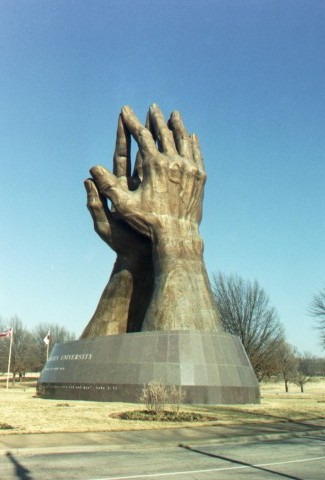
George Pearsons, the chairman of ORU's Board of Regents, also is going back on what he publicized as God's request. I applaud him for taking a stance against this economic corruption, but Pearsons demonstrates why claiming to speak God's word can become a problem. I don't mean to denigrate Pearsons, because he didn't expect Roberts to be corrupt, so I can't fault him for saying what he truly believed.
Yet, when these leaders — who are looked up to by many students and parishioners — project themselves as models of Christian values and violate these values, where does that leave those in their spiritual guidance?
In addition, I have an update to Roberts' connection with The Church Business inquiries, which I've been covering for weeks now. Pearsons is in fact the son-in-law of Kenneth Copeland, one of the preachers currently under investigation by the Senate (follow the above link for more info. on that situation):
When George Pearsons accepted the position of chairman of the ORU regents in May, he said in an address to the board: "I am standing here today because the Lord clearly spoke to me and said, ‘Do whatever Richard Roberts asks you to do,'” according to a copy of the address.
Pearsons is the son-in-law of Kenneth Copeland, a televangelist and ORU regent. Pearsons said in the address that the "covenant” between the Roberts and Copeland families also contributed to his decision to accept the chairman position. He said the "families are forever connected.”
Holding the Roberts in such high regard is typical of many ORU regents, particularly the other ministers and televangelists serving on the board, the president of a religious watchdog group said.
"They all, in essence, pay obeisance to Oral. They all almost bow down in Oral's presence,” said Ole Anthony, president and co-founder of Trinity Foundation, which has investigated religious organizations, including ORU, for decades.
But after the lawsuit was filed and regents initiated an outside review of the claims, Pearsons' stance appeared to change.
Pearsons recently said "the buck stops with the board” when it comes to Richard Roberts' future at ORU. He has maintained that stance, despite the Roberts' public claims of innocence and Oral Roberts' vow that his son would return to power.
This delineates pretty well an example of what amounts to a Royal Family in American Evangelicalism. I wonder how common these kind of connections might be?
Thursday, November 29, 2007
Update: Oral Roberts' presidential resignation
A continuation to my story from yesterday covering the recent resignation of Oral Roberts University president Richard Roberts:
In an unsurprising move, Roberts claims that God asked him to resign from the position, to which, appropriately, he conceded. 
From the article:
“Roberts has previously said that God told him to deny the allegations. The week the lawsuit was filed, Richard Roberts said that God told him: ‘We live in a litigious society. Anyone can get mad and file a lawsuit against another person whether they have a legitimate case or not. This lawsuit ... is about intimidation, blackmail and extortion.’
On Wednesday, Roberts said God told him he would "do something supernatural for the university," if he stepped down from the job he held at the 5,700-student school since 1993.”
I hate to be a cynic when it comes to people claiming divine revelation, because I simply can’t prove (nor do I want to) what God may or may not be saying to them. But this challenges the view of an infallible God – why does it seem like He can’t make up His mind a lot of the time? Why would God have waffled on this, originally telling Roberts to deny the allegations of defrauding a spiritually-charged organization dedicated to the Lord's name?
However, at the same time, it appears the university has received a fortuitous gift in concert with the resignation: $70 million from an Oklahoma businessman. This clearly fits into Roberts' revelation that God would do something for the university if he resigned. Or, a faithful philanthropist wanted to help the university out of the $50 million in debt Roberts helped accrue, and made sure he was gone before making the donation. Either way.
POSTSCRIPT: In line with my previous coverage of the recent Senate investigation into several megachurch preachers, here’s an ironic (or telling) addendum from the second article (links to my former stories where appropriate):
“Sen. Chuck Grassley, R-Iowa, recently announced a Senate investigation into whether six celebrity preachers violated their organizations’ tax-exempt status by living lavishly on the contributions of small donors.
Three of the six are members of the Oral Roberts board: Creflo Dollar, Benny Hinn and Fort Worth-area evangelist Kenneth Copeland.”
Monday, November 26, 2007
Megachurches play key role in local economic development
Like this is any surprise. . .
This New York Times article from last Friday explains something that is not terribly shocking to any of us here at the Quail and abroad, as we've been covering the vast depths of American Christianity's bottom line for several weeks running now.
In this context, the story leads with an inspiring anecdote from Anchorage, Alaska, where a megachurch is supporting strong development in the community.
I think this can be wholly positive, and there's no question that a church's place — according to Christian belief — is to support the community. However, as we've been discussing here previously, where is the line drawn between Church and State, and more importantly, between God and Mammon? 
From the article:
"Indeed, some huge churches, already politically influential, are becoming catalysts for local economic development, challenging a conventional view that churches drain a town financially by generating lower-paid jobs, taking land off the property-tax rolls and increasing traffic.
But the entrepreneurial activities of churches pose questions for their communities that do not arise with secular development.
These enterprises, whose sponsoring churches benefit from a variety of tax breaks and regulatory exemptions given to religious organizations in this country, sometimes provoke complaints from for-profit businesses with which they compete — as ChangePoint’s new sports center has in Anchorage.
Mixed-use projects, like shopping centers that also include church buildings, can make it difficult to determine what constitutes tax-exempt ministry work, which is granted exemptions from property and unemployment taxes, and what is taxable commerce."
In any case, this is not necessarily problematic from a business standpoint. The "for-profit" companies can be pissed all they want, but the name of the game is competition, and the churches have a leg up on them from a tax-break standpoint. From this perspective — and I don't think anyone would deny this — these churches are capitalistic geniuses.
However, is that the message these Christians want to send?
"The church’s leaders say they hope to draw people to faith by publicly demonstrating their commitment to meeting their community’s economic needs.
'We want to turn people on to Jesus Christ through this process,' said Karl Clauson, who has led the church for more than eight years."
Looking at this statement, it appears that there's cut-throat competition in the spiritual market as well. Again, there has been a longstanding relationship between American Protestantism and the capitalist economics — numbers of saved souls and accumulation of (rapidly decreasing in value) paper being the abstract indicators of wealth, respectively — and these kind of endeavors only seem to be merge the two realms further.
Thursday, November 15, 2007
An insider's perspective on "The Church Business"
Recently, I've been posting heavily on Senator Charles Grassley's (R-Iowa) recent inquiry into several major religious figures across the country.
The latest update is here, which outlines the specific points that Grassley will focus on in his investigation:
“Ken Behr, president of the Evangelical Council for Financial Accountability, told Church Executive, a business magazine for larger and mega churches, that Senator Chuck Grassley is likely to probe into concerns over excessive compensation, income unrelated to the business purpose of the ministries, and perks or what is known as ‘excessive benefit transactions.’”
And now, as a Pasty Quail exclusive, a friend of Greg's has had some personal experience with one of the pastors in question, Bishop Eddie Long from Lithonia, Ga. (pictured here) 
Following is Matt Tripp's account of Long's persona, which, after reading the story, you'll agree is literally larger than life:
"Your commentary regarding the business of church reminded me of my personal experiences with "Bishop" Eddie Long. Short version: The dude is a crook, flat out. Before law school, I worked at Preferred Jet Center at McCollum Field in Kennesaw. Long's salary, house and cars made the news. What the AJC didn't tell you about was Long's airplane. He has a Gulfstream II hangared at PJC. What does a pastor need a jet capable of flying internationally for? Well, he purportedly has a "ministry" in the Bahamas. Conversations with the flight crew, however, revealed these were more vacations than "mission trips." I've attached a picture of his airplane...note the New Birth logo on the tail.
A couple of oddities about Long:
1. Long requires his flight crews to be completely African-American. Now, one can hire whomever one wants as an employee, that's fine. But his aircraft is managed by a charter company, who provides the flight crews. As a result, they have to juggle their crew schedule to make sure his plane always has black pilots when he's using it.
2. In addition to my fueling and towing responsibilities as a lineman, part of my duties at Preferred were to load luggage, valet cars, etc. Not in the case of Long. We were the "invisible help" when he was around. We were not to touch anything belonging to Long such as his luggage and his personal vehicles. Nor were we to approach Long or speak to him. He is the only client I have ever had who a rule forbidding us to talk to him. I've spoken to Steve Spurrier, Sylvester Croom, Tommy Tuberville, numerous CEOs, Tom Glavine, Chipper Jones, Burt Reynolds, Toby Keith, Alan Jackson, and even Mariah Carey. All were more approachable than this supposed man of God. He even has a security detail. Really, the only other person that ever came into PJC with a similar level of security was Israeli Prime Minister Ehud Barak.
3. Speaking of the car, I never saw the Bentley. Whenever he came to the airport, he always arrived in a DUB Chrysler 300C Hemi. Long required that his vehicle be kept in the hanger and not in the long-term parking lot. PJC's insurance forbids vehicles inside the hangar (in order to prevent damage to aircraft). Yet Long's vehicle was always accommodated (only one specific employee of the charter company was permitted to drive it...this proved to be a bit problematic when we had to move it to rearrange aircraft and this employee wasn't at work). The kicker is, Long is the only person who ever requested hangar space for his vehicle. PJC's long-term parking lot routinely had Range Rovers, Maseratis, Ferraris, Porsches, BMWs and Mercedes stored in it...but his POS Chrysler had to be kept inside. Go figure."

Pretty intense stuff. Many, many thanks to Matt for his readership and his willingness to disclose this important information with regards to this story.
Wednesday, November 14, 2007
Romney spends subtle amounts of money on television advertising
In the Pasty Quail spirit of updating previously reported news, Mitt Romney is spending $85,000 a day on TV ads, putting his total to $10.2 million at this point.
I reported a story on how much would be spent for the election, and it looks like that figure should be no problem.
Maybe I'm just not watching enough TV, or the right channels, but I haven't seen any Romney ads. I guess they're focusing more in Iowa, New Hampshire and South Carolina, but I want in on this action too. There's going to be nothing better than a bunch of ads showing Hillary in devil horns. 
More (Bad) Financial News
Sorry to keep bringing up bad news on the economy, but there isn't much good to report these days. Unsurprisingly, there has been more fallout from the collapse of the subprime credit market.
CNNMoney is reporting that Bear Stearns, a New York-based financial firm, will devalue its subprime market assets by $1.2 Billion and subsequently show a loss for the third quarter of this year. Additionally, Countrywide Financial Corp., the nation's largest lender, has stated that reducing subprime its lending operations has played a major role in a 48% drop in loan origination for October.
Although these statements are evidence that the worst is yet to come for the economy, it is a good sign that the big financial firms are attempting to right the ship, own up to the flaws in the system, and lay the ground work for a stronger market in the future.
The Black Market Candy Trade
 Reason Magazine posts an amusing story from Boulder, CO about a high school student and his thriving black market candy business at his school where the sweet stuff has been banned. From the post:
"I offered to help him buy the product, if he would pay me back,” Richard said. “We sat down and did the math. He was getting 90 in a box that cost about $12 dollars. Based on what he was able to sell an AirHead for, he was getting a 900 percent profit — almost a tenfold markup. That seemed like a pretty good enterprise. He was clearing at least $150 a week in profit."
Back to bad financial news
 Even though the stock market rose and oil prices fell yesterday, it appears that gas prices are going to skyrocket in the next few weeks.
The title of this article notwithstanding (who puts the colon at the end of a headline??), warning people about gasoline spikes is really kind of useless. We're going to be paying for it either way, but at least we'll be prepared for it. Just don't be "that guy" who rushes to the gas station to fill up before prices rise 20 cents. You're still going to have to get gas in two weeks.
Tuesday, November 13, 2007
More on the WGA Strike
Here is a handy list that outlines just how many episodes are left before your favorite show is forced into reruns.
Also, in related news, pmarca.com has an excellent run-down on the strike and the potential ramifications. Be sure to take a look at his vision of the future where hundreds of new media companies spring up in the wake of Hollywood's implosion. Sounds great to me!
For more on Hollywood's impending downfall, take a look at the International Herald Tribune's piece on a report that movies are no longer profitable.
Heeeey, some good financial news! Wal-Mart aides first stock market rise in 4 days

Several major stocks — including Wal-Mart, Goldman Sachs, Bank of America and The Home Depot — rose today, putting Wall Street back in the economy's good graces for at least an evening.
From the article, which can articulate and present financial news much better than I can:
"Wal-Mart, the world's largest retailer, reported third-quarter profit surpassed projections and hinted that consumer spending might be stronger than anticipated this holiday shopping season. The results also showed that heavy discounting during the period did not hurt margins, which the company said bodes well for the fourth quarter.
A sharp pullback in energy prices also encouraged Wall Street. Oil prices plummeted after the International Energy Agency reduced its expectations for demand in the fourth quarter and next year and said crude supplies are growing. Light, sweet crude for December delivery fell $3.45 to settle at $91.17 a barrel on the New York Mercantile Exchange.
According to preliminary calculations, the Dow rose 319.54, or 2.46 percent, to 13,307.09."
That's all I got, but the holiday season should bring some light to the current economic downslide, so that might be good as well.
Monday, November 12, 2007
Follow-up on The Church Business: Creflo Dollar publicizes his church's earnings
 Last week I posted an article on the The Church Business, which covered specifically a probe into the exploits of several preachers from the Atlanta area as well as other news regarding the marriage of Christianity and free market capitalism.
As an update to that story, Creflo Dollar, the pastor of World Changers Church International in College Park, Ga. (and pictured here), announced his church's earnings this weekend, which checked in around $69 million in 2006.
The article here brings in the perspectives from both sides of Senator Charles Grassley's probe into Dollar's income.
As many of us know, "the government treads carefully when it comes to walking in religion’s orchard. The federal government does not tax ministries." By not taxing ministries, it certainly makes embezzlement a relatively simple task. While ostensibly, there should be a level of trust associated with a preacher, as Dollar seems to imply, the law in this case — appropriately — trusts no one and is searching simply for information:
"Grassley said his probe has nothing to do with religion. 'I’m not interested in doctrine, just the tax laws,' he said. He has looked at the high-roller lifestyles of TV ministers and wonders whether church leaders are using the breaks given to them to enrich themselves."
Justifiably, "Dollar said he understands the senator’s worries but is concerned at the same time about the government sticking its nose into religion’s business. Dollar said he is having legal experts look over the senator’s request."
I think this is perfectly plausible; Dollar not only does not take a salary from the church, but he also has investments in other lucrative interests. The point the article seems to say, though, that the vast wealth of some of the largest U.S. churches seem focused on something other than God, saying:
Dollar is particularly concerned the government may be trying to divine what people can or cannot believe. And Dollar believes in prosperity.
The six religious broadcast empires under the gun all preach and teach forms of a gospel that justifies the accumulation of money and material goods as one sign of God’s blessing. It includes benefits like health, a good family life and benevolence toward others.
"It is an American-born faith that mixes Christianity with capitalism, individualism and materialism," said Shayne Lee, a Tulane University sociologist who studies megachurches and religion.
It became popular in the 1980s, with Reaganism, a rising stock market, growing middle class and consumerism.
As early 20th century sociologist Max Weber once aptly observed (as well have many others), the capitalist drive to accumulate wealth supports a Protestant work ethic that seeks God's favor with a similar zeal.
In this respect, preachers proposing that wealth is a reflection of spiritual health has been around for centuries. Yet, tithing to support the church has been around for all ages, and with all the excess money that people have at their disposal, is it surprising that these churches make a lot of money? Especially since the church runs without government support, it needs to be upheld by its parishioners.
Everyone rails Scientology because it's "only a scam," and people have to pay money in order to receive "higher revelations." Yet, as I've reported from time to time — Tom Cruise notwithstanding — Scientology has helped many people. The question is: Do they just look crazy because they are up front about running their church like a business?
EDIT/UPDATE: Here are some more links on Grassley's probe, including someone railing on Scientology! (that's kind of funny)
Also, see here to read about the whole story again, and here for more information on televangelist Kenneth Copeland's private jet.
Friday, November 9, 2007
Southern Baptist Convention censures dissenting opinion
 Anyone surprised?
The Southern Baptist Convention has censured one of its preachers, Wade Burleson, for "multiple violations" of the organization’s International Mission Board's policy.
From the article: "The censure motion stated that Burleson had 'repeatedly failed' to abide by provisions in the code of conduct adopted in March 2006 governing trustee service, including requirements that trustees 'refrain from public criticism of Board approved actions' and 'scrupulously avoid either the fact or the appearance' of having disclosed information or private conversations from trustees meetings.
The motion also cited requirements that trustees 'speak in positive and supportive terms as they interpret and report on actions by the board, regardless of whether they personally support the action' and that trustees 'are to refrain from speaking in disparaging terms about IMB personnel and fellow trustees.'"
I understand that there isn't an issue from the committee's perspective: their rules are cut and dry. However, the censure raises questions of how the "committee" actually functions; what is the point of a committee if there is to be no disagreement on its decisions?
Here's Burleson's own take on the matter.
Perimeter Center Preparing For Next Condo Boom
The AJC has a story about the area directly surrounding Perimeter Mall and just North of Atlanta. From the article:
"A dozen towers — some 20 stories tall — are on the drawing board. If all the towers are erected, more than 10,000 people would live in 5,805 condo units scheduled to be built over the next three to 10 years. This puts Perimeter in line to become the kind of mini-city emerging at Atlantic Station, along Peachtree Street near the Fox Theatre in Midtown and in Buckhead. People can live within walking distance of their jobs, shops and a MARTA stop."
The traffic in that area can be horrendous; let's hope that with more people actually living there (as opposed to driving in for work and shopping) that they will be more inclined to walk or use public transportation.
Also, does Atlanta really need more condos?
Thursday, November 8, 2007
Deep Breath: News Dump
As I've been having trouble getting my synapses to fire all day long, hopefully my thoughts conveyed themselves well in my previous post. I have another one online, so hopefully that will make its way up today. In the meantime, here are some new news items and some leftovers for your early afternoon perusal.
- Possibly of highest importance, the Canadian Dollar is now at $1.10. Shit. In fact, there’s a lot more going on with the dollar, and here are a BUNCH of economic issues.
- From the world of film, here's a review of the new Bob Dylan flick. If it's anything like any other Dylan film, it should be pretty awesome.
- Floating in the abyss of the weird, Scientologists are being harmlessly useful.
- Finally, in lighter news, Disney's Michael Eisner calls the Hollywood writers' strike "stupid." Hmmm, is that because they're trying to take money from you that's rightfully theirs? Incredible.
The Church Business

Yesterday, I mentioned the spiritual dilemma of one of the largest megachurches in the U.S., which displayed a unique change of heart from one of the chief purveyors of American Christianity's love affair with capitalism. Though pastor Greg Hawkins' statements may send his community up in arms (what do you say when your pastor admits he's been incorrectly preaching to you, and you've believed everything he's said?), I admire his honest attempt to be a beacon for the Lord, and reevaluate himself where he sees issues with his ministry — for better or for worse.
On a slightly related topic, I have a couple more stories regarding the other side of church doctrine, the one that is after the bottom line.
First off, the Atlanta Journal-Constitution reports that U.S. Senator Charles Grassley of Iowa is probing several preachers across the nation (two of which are in the Atlanta area), all "known for preaching that financial blessings are part of Christian life." This invocation is not terribly uncommon; however, Grassley's inquiry comes in context with these preachers' propensity to live well beyond the means of their congregations.
For example, Bishop Eddie Long of New Birth Ministry in Lithonia, Ga., already was investigated by the AJC, which ran a story in 2005 "that looked into Long's founding of a charity that paid the minister more than $3 million over a 3-year period, bought him a $1.4 million house and paid for the use of a $350,000 Bentley car."
Other stories of the like fit in here, and it raises the question of where all the money these churches are making goes. Clearly, there is much charitable work being done, and obviously, much of the capital goes into improving church facilities (see the sprawling campus of Marietta, Ga.'s Johnson Ferry Baptist Church for an example); however, much of that money often goes into the pastor's pocket.
While I do hope that these allegations are untrue and that they are isolated cases, the cynic (some might call it realist) in me believes that these investigations are occurring with legitimate cause. These large churches, especially in affluent areas, make ungodly amounts of money (pun intended), and under the whole "separation of Church and State" premise, many of the church leaders sneak their way around paying taxes.  Moving westward, New Life Church in Colorado Springs — famed parish of the notorious Ted Haggard — is in rebuilding mode in the wake of Haggard's homosexuality scandal.
Basically, Haggard was one of the chief voices in American Evangelicalism, consistently decrying homosexuality as well as dealing with other moral/political issues, until he was mired through the outing of his relationship with a male prostitute in addition to his penchant for methamphetamine use.
Yesterday, The Colorado Springs Gazette reported on New Life Church a year after Haggard's dismissal.
Immediately following the scandal, "active membership dropped from 14,000 to 10,000 and donations to the church dipped by 10 percent. Layoffs hit the church’s staff. The church has withdrawn from the national political scene. And New Life members say their swagger is gone, replaced by humility."
However, since Haggard's replacement at the top of the church hierarchy, New Life is back on its feet: “Sunday attendance has jumped from 6,000 to 7,500 since [new pastor Brady] Boyd was named senior pastor in August, and thousands attend high school groups, college groups or small groups throughout the week. Giving is growing, now down about 8 percent to 9 percent from its peak. The church has a $12 million operating budget and 150 full-time staff members.”
In other terms, these situations are quite reminiscent of the famous Enron scandal — or any other large corporate misdeed, for that matter — and the key point in these news items are their financial ramifications. The way in which these churches are represented paints a picture not of a house of worship, but simply a corporation with a corrupt leader.
This, then, begs a question that is commonly overlooked in our capital-obsessed media: what does this do to spirituality in these congregations? If financial success is preached as a sign of Godly favor, how does the revelation that this success has not been legitimate for some of these pastoral figures affect the beliefs of the masses?
Wednesday, November 7, 2007
Megachurch paradigm Willow Creek goes back to the drawing board
 Interestingly enough, one of the most successful megachurches in the United States, Willow Creek in Chicago, recently realized that its propensity simply to grow its numbers as opposed to focusing on preaching the gospel was "a mistake," according to pastor Greg Hawkins.
From the article:
"The size of the crowd rather than the depth of the heart determined success. If the crowd was large then surely God was blessing the ministry. Churches were built by demographic studies, professional strategists, marketing research, meeting 'felt needs' and sermons consistent with these techniques. We were told that preaching was out, relevance was in. Doctrine didn’t matter nearly as much as innovation. If it wasn’t 'cutting edge' and consumer friendly it was doomed. The mention of sin, salvation and sanctification were taboo and replaced by Starbucks, strategy and sensitivity."
This is a particular topic of interest for me at the current juncture in my academic career, but the article is pretty self-explanatory, so I won't go too much more in depth. Basically, this is a perfect representation of many of the problems with what is commonly called the "evangelical" movement (see here for a similar discussion from a few weeks ago). Seeing some of it firsthand, the megachurch focus often loses sight of its individual parishioner in light of the overall amount of "God's work" that it is doing.
In the true Calvinist sense, then, more people means more blessings from God. While this may or may not be true, in his statements, Hawkins seems to have realized that the true purpose of religious worship is lost when people don't understand the foundations of their practice. If a Christian life is supposed to be different from a life connected with American business and popular culture, then clearly, Willow Creek's model needed reevaluation. In my personal experience, I have trouble distinguishing between a Wednesday night worship service at the local megachurch and a concert at the 40 Watt later that evening. Of course, there's not as much booze at the former, but the reaction to the music appears strikingly similar.
Anyhow, the point is that I don't think there is a problem with this practice if people are spiritually connecting with it. However, as Hawkins suggests, that is precisely the problem: there has been a blurred distinction between the secular and sacred worlds for them to the point where he believes it is spiritually threatening for his members. In his words:
"What we should have done when people crossed the line of faith and become Christians, we should have started telling people and teaching people that they have to take responsibility to become ‘self feeders.’ We should have gotten people, taught people, how to read their bible between services, how to do the spiritual practices much more aggressively on their own."
I understand where he's coming from, and respect his honesty in the matter. But, what does this become for the movement that has risen from Willow Creek's example? What does he do with all the money he's made? What do his parishioners do when they hear that their pastor has "been mistaken" in leading their worship?
Subscribe to:
Posts (Atom)

